
The 3 A.M. Idea: A Creator’s Evidence Habit
ScriptShield began as one creator’s 3 a.m. answer to an impossible problem: proving your work is yours without giving up your life to do it. The habit, explained. Part 4 of 4.
Ashe Davis
Founder & CEO, ScriptShield
Ashe Davis is the founder of ScriptShield. She is an optioned Screenwriter, Author, and SaaS Developer, who wanted to help creators prove authorship and protect their intellectual property in the digital age.
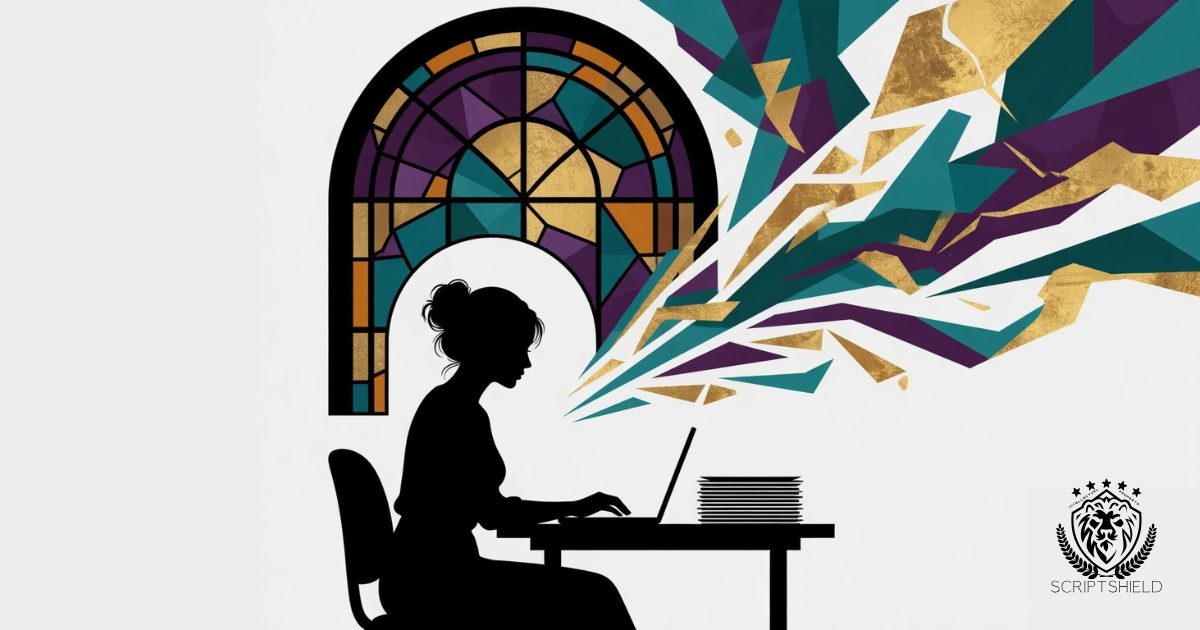
This is the final part of “A Creator’s Story.” Parts 1–3: the work that stayed behind, the privacy breach, and the cost of protection.
The idea arrived at three in the morning, the way ideas do — uninvited, fully formed, and just in time.
By then I had lived all three of the stories in this series. I had watched my creative work dissolve into other people’s businesses without a record. I had been through a breach that taught me how exposed unreleased work really is. And I had done the arithmetic on enforcement and understood why creators walk away from their own rights. Lying awake, the pieces finally arranged themselves into a single, simple sentence:
The evidence has to build itself as you go — or it will never exist at all.
That was the whole idea. Not a vault, not a courtroom, not a promise of justice. A habit — as small as saving a file — that leaves behind a chain of dated, tamper-evident facts: this version existed, on this day, in this creator’s hands, shared with these people, on these terms.
The Short Answer: A creator’s evidence habit has five small parts: fingerprint the seed of each work, chain each significant version, record every share, declare AI involvement honestly, and review monitoring results on a rhythm. Minutes a week, starting from the first draft — so that your history is already organised on the day you need it. The first fingerprint is free.
Why a habit, and not a heroic effort
Every creator I know has tried the heroic version: the weekend spent assembling old drafts into folders, the vow to document everything from now on. Heroic efforts fail because protection that depends on remembering is protection that depends on luck.
A habit is different. It attaches to moments that already exist in your creative life — finishing a draft, sending a file, closing a project — and adds a few seconds of recording to each. The record accumulates the way the work accumulates: quietly, version by version, until one day you look back and find you own a complete, independently verifiable history of your creative life.
“We live in capitalism. Its power seems inescapable. So did the divine right of kings. Any human power can be resisted and changed by human beings.”
— Ursula K. Le Guin, National Book Awards speech, 2014
Le Guin was speaking about the market’s power over books. I hear it as a message to every creator who has been told that losing control of your work is simply how the industry is. Systems feel permanent right up until people build alternatives.
The five-part habit
Fingerprint the seed
The first draft, the outline, the voice memo, the sketch. A SHA-256 hash and an RFC 3161 trusted timestamp anchor the earliest moment of the work to a date no one can quietly move. The first draft matters most.
Chain the versions
Each significant revision links to the one before it, building a timestamped version chain that shows the work’s evolution — the kind of history that is extraordinarily hard to fabricate and uniquely human to possess.
Record every share
Who received which version, when, and under what understanding. Disputes are rarely about whether a work exists — they are about who had access to it. A contemporaneous share log answers that question before it is asked.
Declare AI involvement honestly
Whether a work is fully human, AI-assisted or AI-generated, recording the declaration at creation time — while the facts are fresh — is worth more than any assertion made later. Provenance is becoming the currency of the AI era, and regulators and platforms are beginning to ask.
Review monitoring on a rhythm
I check my monitoring results twice a week, with coffee. Not because a scan can catch everything — no honest service will promise that — but because a rhythm turns the open-ended dread of “is my work out there somewhere?” into a twenty-minute routine with a beginning and an end.
What the habit gave me that I didn’t expect
I built this practice for evidence. What it actually gave me first was peace.
There is a particular exhaustion that creative people carry — authors most of all — from knowing that protecting their rights is an endless task that nobody else will do for them. The habit doesn’t end that task. But it shrinks it to a size that fits inside an ordinary life, and it means the anxious question “could I prove this is mine?” always has the same quiet answer: yes, since the first draft, and it’s all in one place.
What began as one woman’s personal protection process became ScriptShield: an independent platform that records works, versions, declarations and sharing activity, so any creator can maintain a verifiable history of their work over time. It does not grant copyright, decide ownership or promise legal outcomes — honesty about that line is the foundation the whole product stands on. It simply makes sure that when your facts are needed, your facts exist.
“We tell ourselves stories in order to live.”
— Joan Didion, The White Album (1979)
Creators tell stories in order to live. The evidence habit is just one more story — the true, dated, verifiable story of how your work came to be. You are the only person who can write it as it happens. And it is so much easier to write it as it happens than to reconstruct it after everything has gone wrong.
Resources
The full series: Part 1 — The Artist Who Was Never Paid for Her Art · Part 2 — What a Privacy Breach Taught Me · Part 3 — Why Protection Shouldn’t Cost $450 an Hour. Practical guides: your first hash receipt, copyright protection in Australia, and WIPO on automatic copyright protection.
Start the Habit Tonight
One work. One fingerprint. Two minutes. Free — and from then on, your history builds itself as you go.
Get Your Free Hash ReceiptProtect Your Creative Work
Generate SHA-256 authorship certificates and track who sees your scripts, manuscripts, and creative works.
Get StartedScriptShield provides evidence documentation tools for creators. It is not a law firm and does not provide legal advice.