
The Artist Who Was Never Paid for Her Art: On Creative Work That Goes Unrecognised
A founder’s story about creative labour that becomes company assets without credit — and how creators can quietly keep a record of what they make. Part 1 of 4.
Ashe Davis
Founder & CEO, ScriptShield
Ashe Davis is the founder of ScriptShield. She is an optioned Screenwriter, Author, and SaaS Developer, who wanted to help creators prove authorship and protect their intellectual property in the digital age.
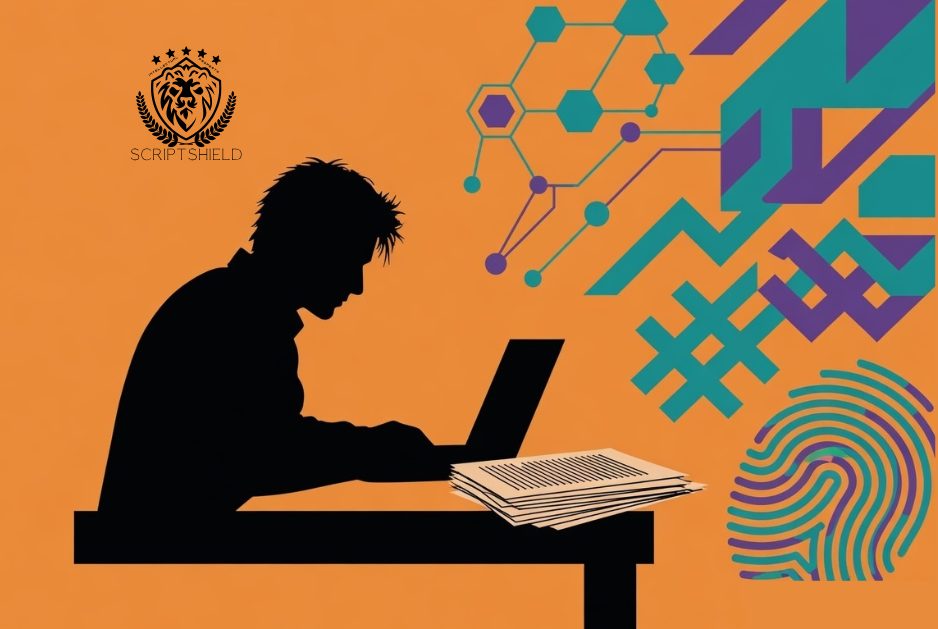
This is Part 1 of “A Creator’s Story” — a four-part series about why ScriptShield exists, told softly, the way it actually happened. Parts 2–4: the privacy breach, the cost of protection, and the evidence habit.
I have spent most of my working life being creative in rooms that didn’t have the word “creative” on the door.
Like a great many women I have met since, I was employed under ordinary titles and paid ordinary wages — while the thing I actually brought to work each day was artistic: the words, the campaigns, the design thinking, the ideas that quietly became part of how the business presented itself to the world. When each role ended, all of it stayed behind. It had become an asset of the company. And I had no record — not one dated page — showing that any of it had ever passed through my hands.
I’m not telling this story to assign blame. I’m telling it because it is so common that most creators don’t even recognise it as a story. It just feels like how things are.
“A woman must have money and a room of her own if she is to write fiction.”
— Virginia Woolf, A Room of One’s Own (1929)
Nearly a century later, Woolf’s point still lands — and I’d add a third thing to her list. A woman needs money, a room of her own, and a record of her own: a dated, private history of what she made, when she made it, and where it went.
The Short Answer: In most countries, creative work made in the course of employment is owned by the employer by default — but attribution and a personal record of your contribution still matter enormously. Keeping a private, timestamped history of what you create protects your professional story even when the copyright itself belongs to someone else. A free hash receipt is one way to start.
The economics of being creative are quietly brutal
The Authors Guild’s most recent income survey found that even full-time, established authors in the United States earned a median of roughly US$20,000 a year from all their writing-related work combined — and far less from books alone. Most creative people subsidise their art with other employment. That is precisely how creative skill ends up folded into ordinary jobs: the receptionist who redesigns the brand, the admin who writes every word the company publishes, the clerk whose campaign ideas become the sales strategy.
None of that shows up on a payslip as “creative work.” And none of it shows up anywhere at all — unless the creator herself keeps the record.
What the law actually says about work you make on the job
This part matters, and it is worth knowing calmly and precisely.
In Australia, under section 35(6) of the Copyright Act 1968 (Cth), copyright in work you create “in pursuance of the terms of” your employment generally belongs to your employer, unless your contract says otherwise. The United States reaches a similar result through the “work made for hire” doctrine in 17 U.S.C. § 101. The United Kingdom does the same under the Copyright, Designs and Patents Act 1988.
But there are two things employment does not automatically take from you:
Your moral rights
In Australia, moral rights — including the right to be attributed as the author of your work — belong to the individual creator under Part IX of the Copyright Act, introduced in 2000. They cannot be sold or transferred, although consent arrangements exist. The Australian Copyright Council publishes plain-English information sheets on how this works.
Work made outside the course of your employment
The novel you write at your own desk on Sunday, the app you build from your own idea, the songs, the scripts — employment ownership generally reaches only work made in the course of the job. The boundary can be genuinely contested, which is exactly why contemporaneous records of when and where something was created matter so much.
The gentle practice I wish someone had taught me at 25
Nobody is going to keep your professional history for you. Here is the quiet practice I would hand to every creative employee, freelancer and artist — especially the women doing creative work under non-creative titles:
“You can’t use up creativity. The more you use, the more you have.”
— Maya Angelou
That quote is why this story ends gently rather than bitterly. The work that stayed behind did not empty me out. But I did learn, the long way, that talent without a record is easy to absorb and easy to forget — and that a record costs almost nothing to keep, if you start now.
Resources
Organisations that genuinely help creators in this situation:
Arts Law Centre of Australia — low-cost and free legal advice for artists and creators. Australian Copyright Council — free information sheets on employment, moral rights and ownership. The Authors Guild (US) — advocacy, contract reviews and income research for writers. WIPO — how automatic copyright protection works internationally.
Start Your Own Record
Your first hash receipt is free — a timestamped fingerprint of one work you made, held in your name. It takes two minutes, and it is yours.
Get Your Free Hash ReceiptNext in this series: Part 2 — What a Privacy Breach Taught Me About Protecting Creative Work.
Protect Your Creative Work
Generate SHA-256 authorship certificates and track who sees your scripts, manuscripts, and creative works.
Get StartedScriptShield provides evidence documentation tools for creators. It is not a law firm and does not provide legal advice.