
Creator Rights Protection: The Office You Never Had
Publishers have rights teams. Labels have licensing departments. Independent creators have themselves. ScriptShield changes that equation entirely.
Ashe Davis
Founder & CEO, ScriptShield
Ashe Davis is the founder of ScriptShield. She is an optioned Screenwriter, Author, and SaaS Developer, who wanted to help creators prove authorship and protect their intellectual property in the digital age.
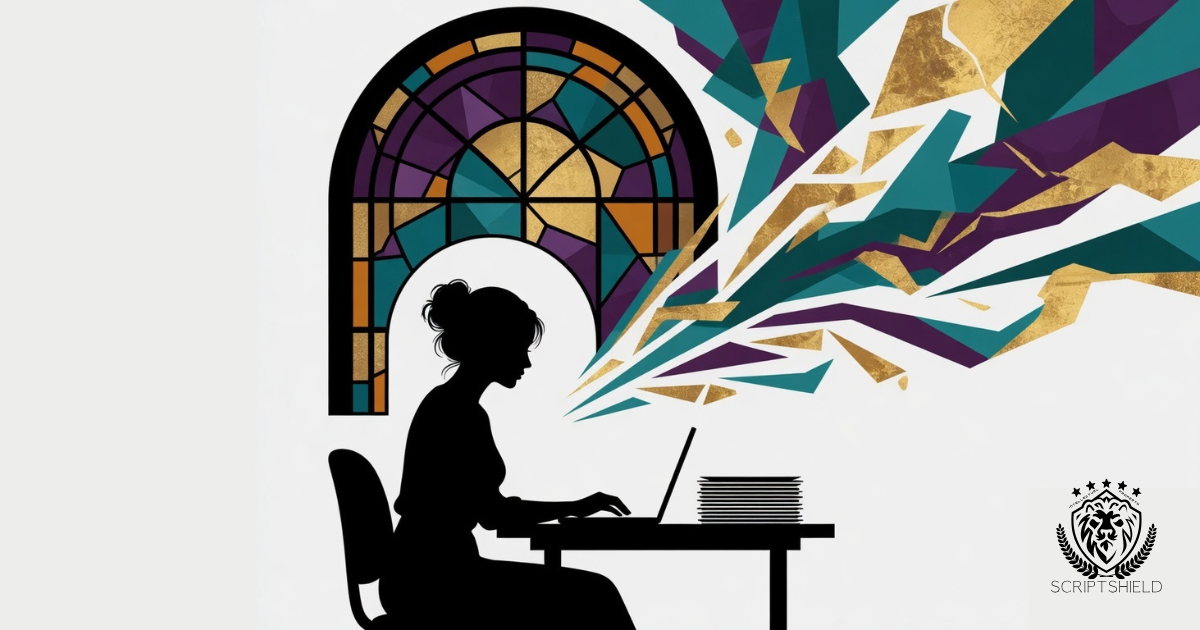
Every major publisher has a rights department. Every studio has a chain-of-title team. Every record label has licensing administrators and royalty accountants. Every large media company has lawyers on retainer who respond to infringement within business hours.
You have yourself.
That has always been the gap. Not talent. Not copyright. Not legal rights. The gap is operational infrastructure — the persistent, daily work of recording, monitoring, documenting, licensing and responding that transforms a legal right into practical protection. ScriptShield is designed to close that gap for independent screenwriters, authors and musicians who carry the same rights as any institution but none of the infrastructure.
This week, the Prime Minister told the nation that creators control their work. That is correct. What he did not say — because it is not the government’s job to say it — is who performs the operational work that makes control real.
The Short Answer: Independent creator rights protection has always lacked the operational infrastructure that publishers, labels and studios take for granted. ScriptShield is the creator protection office — recording your work, watching for possible unauthorised use, organising your evidence and preparing what you need to respond. Start with a free hash receipt.
What does a publisher’s rights department actually do?
It performs five functions that most independent creators cannot replicate alone.
Recording
It maintains a registry of every work, edition, format, territory, contributor, contract, licence and rights reversion in the publisher’s catalogue. When a question arises about who owns what, the answer already exists in a structured record.
Monitoring
It watches for possible unauthorised editions, pirated copies, unlicensed translations, reproduced passages, AI training-set inclusions and derivative publications. The Arts Law Centre of Australia has found that this monitoring work is intensely time-consuming and expensive for individual artists. Major publishers outsource it to specialist firms.
Licensing
It negotiates subsidiary rights, translation licences, adaptation agreements, educational permissions and digital distribution terms. Every agreement is recorded, bounded and connected to the specific work and edition it covers.
Evidence preservation
When a potential infringement is discovered, the rights department captures the evidence — the listing, the date, the seller, the comparison to the original — before it can disappear. It organises that evidence into a usable record.
Response
It determines the appropriate action: a cease-and-desist letter, a platform takedown notice, a licensing negotiation, a legal referral or simply a note that the use was authorised. Every response is documented.
These five functions do not require legal expertise. They require systems, persistence and organisation. A lawyer enters the picture when the evidence is assembled and a legal strategy is needed. The lawyer’s effectiveness depends almost entirely on the quality of the record that preceded them.
Why can’t independent creators do this themselves?
They can. Some do. But the cost in time, attention and emotional energy is extraordinary.
Consider a working novelist with eight published titles. Her books exist as hardcovers, paperbacks, ebooks, audiobooks and foreign editions across multiple territories. Some are in print. Some have reverted. Some are licensed to different publishers in different regions. At least one has appeared, in whole or in part, in a pirated dataset used for AI training.
To protect her catalogue manually, she would need to maintain a spreadsheet of every edition, contract, territory and licence. She would need to run regular searches across retail platforms, pirate sites, AI dataset repositories and social media. She would need to preserve screenshots and evidence before listings change. She would need to determine whether each discovered use was authorised. She would need to draft and send appropriate responses. And she would need to do all of this while writing her next book.
Most independent creators choose the book. The monitoring, evidence and response work simply does not happen. Not because they do not care about their rights — because the operational burden is unsustainable.
How does ScriptShield function as a creator protection office?
By performing the same five operational functions a publisher’s rights department handles — recording, monitoring, licensing records, evidence preservation and response preparation — through a connected system designed for independent use.
Recording
When you add a work to ScriptShield, the system generates a SHA-256 cryptographic hash and an RFC 3161 trusted timestamp, creating a tamper-evident record that this specific file existed at this specific moment. Each subsequent version extends the timestamped version chain. Your AI & Human Authorship declaration records how the work was created. Your AI Training Rights Passport records your terms. The Rights Graph connects everything — work, versions, declarations, permissions, disclosures, recipients.
Monitoring
ScriptShield uses a proprietary, compliance-controlled forensic process to monitor protected works across supported sources. It watches for possible copies, altered versions, reproduced passages and related publications. When something is found, the finding is connected to the specific protected work, not just presented as an unexplained alert.
Licensing records
Every permission you grant — to a publisher, an agent, a platform, an AI company — can be recorded in the Rights Graph with the specific work, use, terms, duration, territory and conditions. When a finding is discovered, the system checks whether an existing licence or permission may explain the use.
Evidence preservation
Findings are preserved with the discovered location, capture date, evidence snapshot, matching method, confidence level and the relevant source work. This evidence enters the Rights Graph as a documented event rather than a loose file on your desktop.
Response preparation
ScriptShield organises findings into an evidence record that separates authorised use from unresolved use and prepares the information you need to make an informed decision. It does not make legal findings. It does not automatically label anybody an infringer. It prepares the documented foundation that makes professional advice — or your own informed action — practical.
What ScriptShield is not
This distinction matters for trust.
ScriptShield is not a law firm. It does not provide legal advice, represent creators in disputes or make legal determinations about infringement. Copyright infringement is a legal conclusion that requires professional assessment of the specific facts, the applicable law and the relevant jurisdiction.
ScriptShield does not independently establish authorship. It records that an identified account submitted a particular work by a particular time. Combined with version histories, declarations and disclosure records, this evidence strengthens claims significantly — but the weight of that evidence in any proceeding depends on the court, tribunal or licensing body assessing it.
ScriptShield does not replace collecting societies. Organisations like APRA AMCOS, Screenrights and Copyright Agency perform essential licensing and royalty functions that ScriptShield does not duplicate. ScriptShield provides an additional provenance, monitoring and evidence layer that sits alongside collective rights administration.
The honest positioning is this: ScriptShield performs the persistent investigative and administrative work that usually prevents an independent creator from ever reaching a lawyer with a usable case.
What should an independent creator do today?
The Bottom Line
The PM said the right thing this week. Creators control their work. But control without infrastructure is aspiration without mechanism. The large institutions already have the infrastructure. Independent creators have been expected to build it themselves, in their spare time, with no budget and no training.
ScriptShield is the creator protection office you never had. Not a law firm. Not a replacement for human judgement. An operational system that records your work, watches for possible unauthorised use, organises your evidence and prepares what you need to respond.
Open Your Protection Office
Start with a free hash receipt. Add your catalogue. Set your terms. Let ScriptShield handle the persistent operational work while you focus on creating.
Start With a Free Hash ReceiptProtect Your Creative Work
Generate SHA-256 authorship certificates and track who sees your scripts, manuscripts, and creative works.
Get StartedScriptShield provides evidence documentation tools for creators. It is not a law firm and does not provide legal advice.