
Copyright Monitoring Creators: Who Is Watching Your Work?
Your books, music, art and designs keep moving after publication. Large publishers have rights teams. You have yourself. ScriptShield changes that.
ScriptShield Team
ScriptShield
We build tools that give screenwriters and creators cryptographic proof of authorship. Because your work deserves evidence as strong as your story.
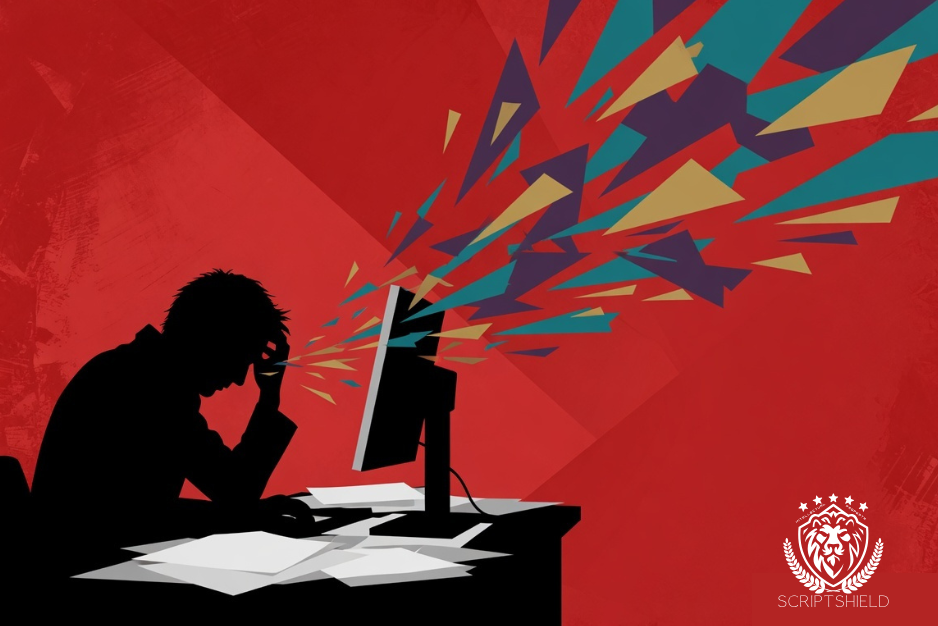
You wrote the book. You released the album. You published the portfolio. And then the work kept moving.
It was downloaded, reposted, adapted, translated, sampled, reproduced and uploaded to places you will never think to search. Somebody put your cover art on a print-on-demand mug. Somebody fed your manuscript into a dataset. Somebody uploaded your track to a platform you have never heard of in a territory you never licensed.
Large publishers and studios have rights teams, monitoring services and lawyers. Most independent screenwriters, authors and musicians have themselves. ScriptShield is built for exactly that gap.
This week, the Prime Minister said Australian creative works should not be used for AI training without the creator’s control. That matters enormously for the future. But for creators whose work is already circulating, the immediate question is simpler and more personal: who is watching it right now?
The Short Answer: Copyright monitoring for independent creators has been prohibitively expensive and technically fragmented. ScriptShield creates a connected rights record for your published catalogue and watches for possible copies and related uses, so you receive evidence instead of unexplained alerts. Protect your catalogue today.
Why does published work need ongoing protection?
Because publication increases exposure, and exposure increases risk.
The Arts Law Centre of Australia has found that monitoring unauthorised use is intensely time-consuming and expensive for artists, while takedown processes differ considerably between platforms. A creator who discovers their book on a pirate site must locate the right reporting form, provide evidence they own the work, wait for a response and follow up if nothing happens. A creator whose music appears in an unlicensed advertisement faces an even harder chain: identifying the advertiser, the agency, the platform and the appropriate legal mechanism for each.
Most creators discover infringement by accident. A fan sends a link. A colleague spots a familiar cover. A Google Alert catches a title. By the time the creator knows, evidence may have already disappeared — the listing changed, the page removed, the file re-uploaded under a different name.
This is not a rare problem. It is the everyday reality for working creators with published catalogues.
What do large publishers have that independent creators do not?
The answer is infrastructure.
A major publisher maintains a rights department that tracks every edition, translation, territory, licence, reversion and subsidiary right across its catalogue. It contracts monitoring services that scan retail platforms, pirate sites, social media and digital libraries. It employs lawyers who can act quickly when a violation is identified.
A major record label has similar resources. APRA AMCOS performs essential licensing and royalty functions for music. Screenrights manages retransmission and educational copying. Copyright Agency handles reprographic and digital reproduction. These collecting societies do vital work — but they are not a universal monitoring service covering every unauthorised copy across every platform, marketplace and dataset on the internet.
Independent creators fall through the gaps. They own the copyright. They may be registered with the relevant collecting society. But nobody is continuously watching their specific works across the specific environments where unauthorised use occurs.
What does creator-controlled copyright monitoring look like?
It begins with the catalogue.
A published author should be able to import every book, edition, cover and audiobook into one protected record. They add publication details, ISBNs, original files and known licences. ScriptShield creates a tamper-evident record connecting the work, its versions, declarations, publication details and rights information. That is the baseline.
From that baseline, monitoring becomes intelligent. It is not just a search alert telling you your title appeared online. It connects each finding to the work itself. It records what was discovered, where it appeared, when it was captured, which protected work it resembles, how strong the match is and whether an existing licence or permission may explain the use.
Every finding becomes part of your Rights Graph. You receive evidence, not another unexplained notification.
For musicians, the same architecture connects compositions, lyrics, demos, masters and published tracks. For filmmakers, it connects scripts, treatments, footage and completed productions. For visual artists, it connects original files, published works and licensed uses.
The distinction matters. A generic search alert says “your name appeared online.” ScriptShield connects the finding to the specific protected work, checks the known permissions and organises the evidence for informed review.
Does monitoring mean ScriptShield will catch everything?
No. And it would be irresponsible to claim otherwise.
ScriptShield uses a proprietary, compliance-controlled forensic process to monitor protected intellectual property, identify potential relationships, preserve discoverable evidence and prepare findings for human review. It watches across supported sources and environments.
But no system can monitor every corner of the internet, every private dataset, every closed platform or every jurisdiction simultaneously. Some copying happens in environments that are inaccessible to any monitoring service. Some transformations are so extensive that the relationship between original and copy is genuinely ambiguous.
What ScriptShield provides is substantially better than what most independent creators currently have — which is nothing. A structured, continuous watching process that connects findings to your original work, checks them against your permissions and preserves the evidence for your decision.
ScriptShield does not make legal findings or replace legal advice. It does not automatically label somebody an infringer. It gives you the organised evidence and documented history that make meaningful action possible.
What can a creator with a published catalogue do today?
You do not need to begin with your next project. Your existing body of work is already circulating — and it deserves protection now.
Import your catalogue
Add your published books, albums, recordings, films, photographs, illustrations, designs or other creative works. Include their publication records, identifiers, original files and known licences.
Build your baseline
ScriptShield creates your catalogue baseline using SHA-256 cryptographic hashes, RFC 3161 trusted timestamps and your declared rights information. A work added today is monitored from today. Earlier publication records provide historical supporting evidence.
Set your permissions
Use your AI Training Rights Passport to record your terms for AI use. Use your three-tier declaration to record authorship status. These records become part of the Rights Graph and inform how any future finding is assessed.
Let ScriptShield watch
Once your catalogue baseline exists, monitoring begins. You focus on creating. ScriptShield focuses on watching.
Start with a free hash receipt
Protect your most important work first. Expand to your full catalogue when you are ready. The point is to begin — because every day without a record is a day your work travels without documentation.
The Bottom Line
You created the work. You should not also have to become its investigator, archivist and infringement administrator.
The PM’s announcement changes the political landscape. Legislation will change the legal landscape. But the practical landscape — the one where your work is downloaded, reposted, adapted and trained on every day — only changes when you build the evidence system your rights deserve.
ScriptShield gives independent creators the always-on protection normally reserved for organisations with dedicated rights teams. Because your work deserves more than hope.
Watch Your Catalogue
Import your published works, set your permissions and let ScriptShield build the Rights Graph that most independent creators have never had.
Protect Your Catalogue TodayProtect Your Creative Work
Generate SHA-256 authorship certificates and track who sees your scripts, manuscripts, and creative works.
Get StartedScriptShield provides evidence documentation tools for creators. It is not a law firm and does not provide legal advice.